
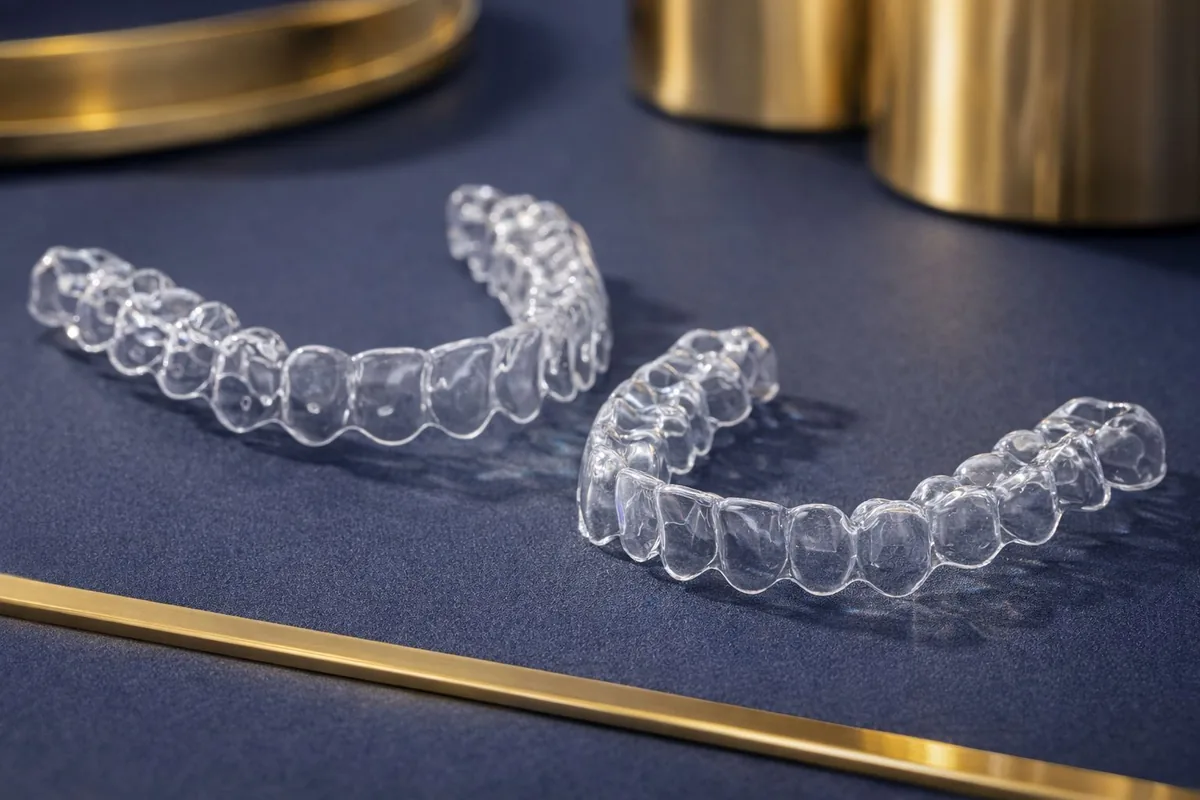
It's usually the second question patients ask about Invisalign, right after "will it work for me?" — how long will I be wearing these things? The honest answer: most Invisalign patients at our Clearwater office finish in 6 to 18 months. Minor fixes can wrap up in as few as 3–6 months; complex cases can run up to 24. Where you land in that range is mostly predictable — and partly up to you. Here's the realistic timeline, stage by stage.
Want your number, not a range?
Dr. Cannady is a certified Invisalign provider for teens and adults. The $99 new patient special — exam, digital X-rays, and a personalized plan — is the easiest way to find out exactly how long your case would take. Rated 5.0 stars by 497 patients on Google.
The Short Answer, by Case Type
- Minor crowding or spacing (a slightly rotated tooth, a small gap, mild relapse after braces) — often 3–6 months.
- Moderate crowding or spacing across several teeth — typically 6–12 months.
- Significant crowding or bite correction (overbite, underbite, crossbite work) — usually 12–18 months, occasionally up to 24.
Two people with "crooked front teeth" can have very different timelines, because what matters is how far each tooth has to move and whether the bite has to change too — not how the smile looks in a mirror. That's why the real answer comes from an exam and a digital scan, not a chart.
What Actually Determines Your Timeline
- How far teeth need to move. Each aligner moves teeth a fraction of a millimeter. More movement means more trays, and each tray is worn 1–2 weeks.
- Whether the bite is involved. Closing a gap is fast; correcting how your upper and lower teeth meet adds months, because jaw-level changes are slower than single-tooth movements.
- Wear time — the part you control. Aligners only work while they're on your teeth: 20–22 hours a day, off only for meals and brushing. Every hour under that quietly stretches the schedule.
- Biology. Teeth move through living bone, and bone remodels at its own pace — somewhat faster in teens, a bit slower with age. Invisalign works well for adults; the timeline just respects the biology.
The Invisalign Timeline, Stage by Stage
Week 1: Consultation and digital scan
Dr. Cannady examines your teeth, gums, and bite — alignment problems sometimes hide decay or gum issues that need treating first — and takes a digital scan. You'll see a 3D simulation of how your teeth will move and get your projected timeline before committing to anything. As a fee-for-service practice, we give you a clear written quote up front, with flexible financing available.
Weeks 2–4: Your custom aligners are made
Invisalign manufactures your full series of custom trays from the approved plan. When they arrive, we fit the first set, place any small tooth-colored attachments that help the aligners grip, and send you home with the next several sets.
The main stretch: new trays every 1–2 weeks
You wear each aligner set 20–22 hours a day and switch to the next set every 1–2 weeks as directed. About every 6–8 weeks you stop by our office so Dr. Cannady can confirm your teeth are tracking with the plan. Most patients say the routine disappears into daily life within a couple of weeks — no food restrictions, no wires, and nobody at work notices. For teenagers, built-in compliance indicators fade with wear, so parents can see the trays are actually being worn — more in our guide to Invisalign for teens.
The last mile: refinements
Near the end, some teeth may need a little extra persuasion. A refinement — a short additional series of aligners from a new scan — fine-tunes the result and typically adds a few weeks to a few months. It's a normal part of treatment planning, not a setback, and it's how good cases become great ones.
After: retainers protect the result
Teeth drift back toward old positions for life, so when treatment ends, retainers begin — full-time briefly, then nights only. This is non-negotiable: skipping retainers is the most common reason people straighten their teeth twice. Many patients also finish with professional whitening, since newly straight teeth make brightness the finishing touch.
Wondering where your smile falls in the range?
Call or text our Clearwater office — we’ll get you scheduled for an exam, scan, and a personalized timeline you can plan around.
How to Finish On Time (or Early)
- Hit 20–22 hours a day, every day. Set phone reminders after meals; the tray goes back in before the coffee refill.
- Change trays on schedule — and if you fall behind, wear the current tray longer rather than skipping ahead.
- Don't lose the case. Aligners wrapped in a napkin end up in restaurant trash cans constantly. A lost tray means wearing the previous one until a replacement arrives — and lost days.
- Keep your checkups, both the 6–8-week Invisalign visits and regular cleanings — healthy gums move teeth on schedule.
Invisalign vs. Braces on Speed
For mild to moderate cases, Invisalign is often as fast as or faster than braces, because every movement is planned digitally from day one. For some complex bite problems, braces remain the more efficient tool — and if that's true for your case, Dr. Cannady will tell you so at the consult. The practical difference is accountability: braces work around the clock whether you think about them or not, while Invisalign's schedule belongs to whoever is wearing (or not wearing) the trays.
Frequently Asked Questions About the Invisalign Timeline
How long does Invisalign take for crowded teeth?
Minor crowding often finishes in 3–6 months, moderate crowding typically takes 6–12 months, and significant crowding or bite correction can take 12–24 months. Most of our Clearwater patients finish in 6–18 months, and you'll get a personalized timeline — with a 3D preview — at your consultation.
Is Invisalign faster than braces?
Often, for mild to moderate cases. For some complex bite problems, braces may still be more efficient. The bigger difference is that Invisalign's speed depends on wear time: 20–22 hours a day keeps it on schedule.
What happens if I don't wear my aligners enough?
Teeth drift back, the next tray fits poorly, and treatment stalls. If you fall behind, wear your current tray until it feels fully passive again and call us — don't skip ahead.
Do I have to wear a retainer after Invisalign?
Yes — full-time briefly, then nights only, indefinitely. Retainers are what make the result permanent.
How often are new trays and checkups?
New trays every 1–2 weeks; office visits about every 6–8 weeks. Many patients get several tray sets at once, so visits are easy to schedule around work or school.
The timeline starts with one visit
Exam, digital X-rays, scan, and your personalized Invisalign plan — $99 for new patients. Patients come to us from Clearwater, Dunedin, Largo, and Palm Harbor.
About the Author
Dr. Christopher S. Cannady is a graduate of the Nova Southeastern University College of Dental Medicine. He has taken hundreds of hours of continuing education, including courses involving full mouth rehabilitations, occlusion, root canals, and more. Dr. Cannady is actively involved with the American Dental Association, the Florida Dental Association, the Academy of General Dentistry, and the American Academy of Implant Dentistry. Curious whether Invisalign is right for you or your teen? Schedule an appointment online or call our Clearwater office at (727) 441-3523.
New to Cannady Dental? Take advantage of our $99 new patient special, which includes a comprehensive exam, digital X-rays, and a personalized treatment plan with Dr. Cannady in Clearwater.